Published Apr 28, 2025
Updated Sep 20, 2026


Updated Sep 20, 2026
Get up to speed on Singapore’s latest preschool fees and subsidies for 2026-2027. As an ECDA-appointed Anchor Operator, My First Skool keeps full-day childcare fees capped at $610 per month before subsidies. Find out how to calculate your subsidies today.
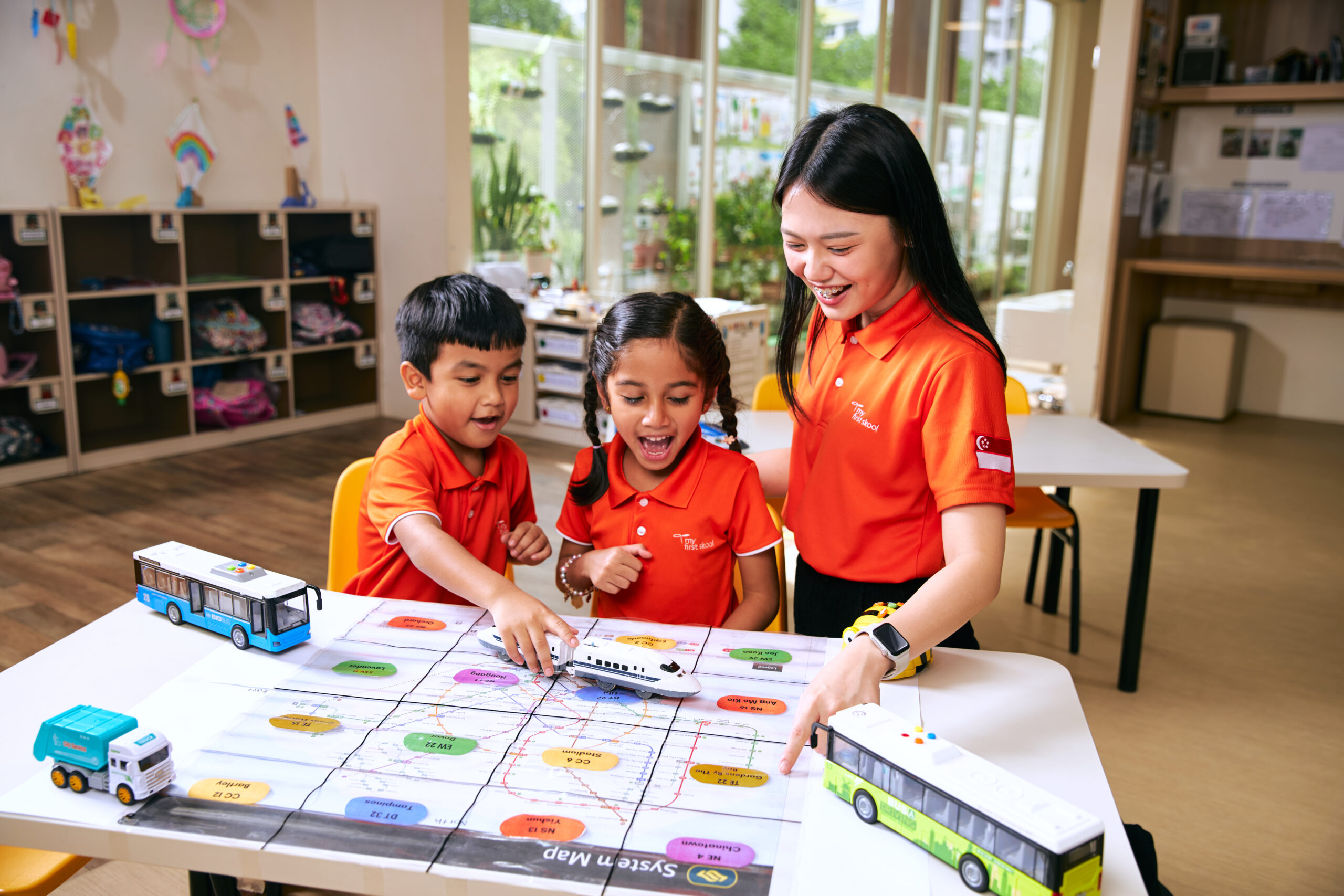
Understanding preschool fees and subsidy schemes shouldn’t add stress to your parenting journey. In Singapore, comprehensive government support helps ensure your child receives high-quality early education while keeping your out-of-pocket expenses manageable.
These financial supports are designed to ease the burden on working parents, significantly offsetting the monthly fees for both infant care and childcare programmes at ECDA-licensed preschool centres.
However, because the exact subsidy amount depends on a variety of factors, including your working status, household income, and the specific programme your child is enrolled in, figuring out your precise out-of-pocket expenses can sometimes be confusing.
Quick Takeaways for Parents
As of 2026, full-day childcare fees are capped at a maximum of $610 per month at Anchor Operator preschools, which includes all My First Skool centres, and $650 at Partner Operator preschools, such as Little Skool-House.
This baseline fee cap ensures that out-of-pocket expenses for full-day childcare at an Anchor Operator remain highly affordable, often comparable to primary school and after-school care fees combined. Coupled with the available government subsidies, many families can expect their net fees to be significantly lower.
Following the Budget 2026 announcement1, and subsequent parliamentary sessions (Budget Debate and Committee of Supply Debate) , the government will be expanding preschool subsidy eligibility. Starting from January 2027, the income ceilings for means-tested preschool subsidies (Additional Subsidy) will be raised. This adjustment will allow over 60,000 more families in Singapore to qualify for higher Additional Subsidies, significantly reducing out-of-pocket childcare costs.
Key changes taking effect in 2027 for Additional Subsidy include:
(Note: The subsidy tables below reflect the current rates valid until December 2026).
Beyond the enhanced preschool subsidies taking effect in 2027, the government also announced immediate support to help parents with child-raising costs. Every Singaporean child aged 12 and below will receive a one-off $500 Child LifeSG Credit.
These credits can be conveniently used to pay for child-related expenses, including medical fees, enrichment classes, and even out-of-pocket preschool expenses – at any merchant or clinic that accepts PayNow or NETS QR, giving parents extra flexibility to manage their daily expenses.
To further keep early childhood education affordable for every Singaporean family, the government has set a long-term target to lower fee caps across major operators4. By 2028–2030, full-day childcare fee caps at Anchor Operators are targeted to drop to $150 per month after basic subsidies for lower- and middle-income families, bringing preschool costs close to primary school expenses.
It is important to understand how subsidies for preschool work, what factors can affect the final amount you receive, so you’ll know exactly what to expect and how to make the most of the subsidy for your child’s preschool journey. The amount of subsidy a family can receive is calculated based on several factors, including the family’s income, the number of children in care, and the type of childcare service used.
Singapore provides two primary types of subsidised childcare5 for families with Singapore Citizen (SC) children enrolled in licensed infant or childcare centres:
These subsidies are designed to make early childhood education more accessible and affordable, particularly for low- and middle-income families. By easing the financial burden, the ECDA supports families in providing quality early childhood education for their children.
For full-day childcare programmes, eligible families receive a monthly Basic Subsidy of $300. Additionally, depending on their means-tested household income, families may qualify for an Additional Subsidy of up to $467 per month to further offset their childcare expenses.
| Applicant’s working status | Gross Monthly Household Income | Gross Monthly Per Capita Income | Basic Subsidy (BS) | Additional Subsidy (AS) – Max AS | Additional Subsidy (AS) – Min Co-Pay # |
| Working Applicant | $3,000 and below | $750 and below | $300 | $467 | $3 |
| $3,001 to $4,500 | $751 to $1,125 | $440 | $25 | ||
| $4,501 to $6,000 | $1,126 to $1,500 | $340 | $115 | ||
| $6,001 to $7,500 | $1,501 to $1,875 | $260 | $185 | ||
| $7,501 to $9,000 | $1,876 to $2,250 | $190 | $255 | ||
| $9,001 to $10,500 | $2,251 to $2,625 | $130 | $315 | ||
| $10,501 to $12,000 | $2,626 to $3,000 | $80 | $365 | ||
| Above $12,000 | Above $3,000 | N/A | N/A | ||
| Non-working applicant | N/A | $150 | N/A | N/A | |
* As announced in Budget 2026, the income ceiling will be raised to $15,000 (HHI) or $3,400 (PCI) starting from 2027, allowing more families to qualify for the Additional Subsidy.
# Please note that a minimum co-payment is always required, regardless of whether your total eligible subsidies exceed the actual programme fees. The amount increases progressively with higher income brackets.
For full-day infant care programmes, eligible families receive a monthly Basic Subsidy of $600. Additionally, depending on their means-tested household income, families may qualify for an Additional Subsidy of up to $710 per month to further offset their infant care expenses.
| Applicant’s working status | Gross Monthly Household Income | Gross Monthly Per Capita Income | Basic Subsidy (BS) | Additional Subsidy (AS) – Max AS | Additional Subsidy (AS) – Min Co-Pay# |
| Working Applicant | $3,000 and below | $750 and below | $600 | $710 | $40 |
| $3,001 to $4,500 | $751 to $1,125 | $640 | $110 | ||
| $4,501 to $6,000 | $1,126 to $1,500 | $500 | $250 | ||
| $6,001 to $7,500 | $1,501 to $1,875 | $380 | $360 | ||
| $7,501 to $9,000 | $1,876 to $2,250 | $240 | $500 | ||
| $9,001 to $10,500 | $2,251 to $2,625 | $100 | $640 | ||
| $10,501 to $12,000 | $2,626 to $3,000 | $40 | $700 | ||
| Above $12,000 | Above $3,000 | N/A | N/A | ||
| Non-working applicant | N/A | $150 | N/A | N/A | |
When assessing your eligibility for the Additional Subsidy, ECDA evaluates your household income based on one of two methods:
Per Capita Income (PCI): Calculated by dividing the total gross monthly household income by the number of family members residing in the same household. This option is particularly beneficial for larger families (with 5 or more family members), as it may qualify the family for a higher subsidy tier.
Gross Monthly Household Income (HHI): The combined gross monthly income of both spouses, prior to CPF deductions.
Navigating subsidy paperwork shouldn’t add to your busy schedule. When you enroll with My First Skool, our dedicated centre staff guide you step-by-step through your ECDA subsidy application. We process all documentation directly on your behalf, so your approved subsidies are applied seamlessly to your monthly invoice, leaving you to simply pay the reduced net amount.
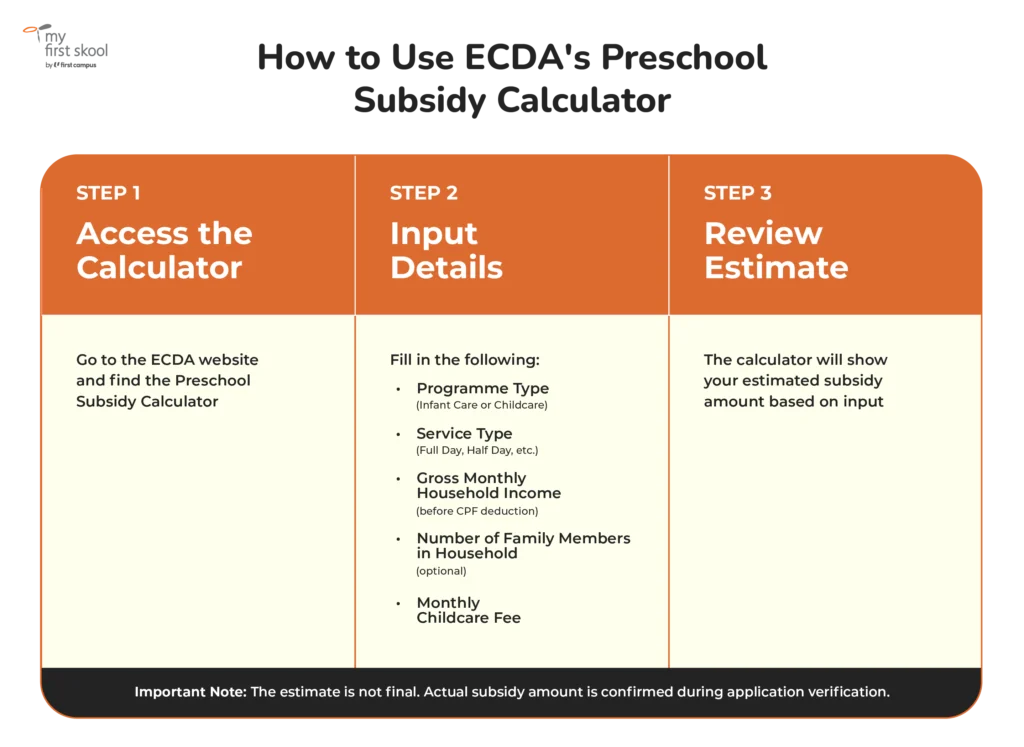
To assist parents in estimating their eligible subsidy amount, the Early Childhood Development Agency (ECDA) provides an online Preschool Subsidy Calculator, designed to help families estimate the amount of financial assistance they may receive for childcare services and infant care in Singapore.
Here’s how you can use it:
Please remember that the figures generated are estimates. The actual subsidy amount will be determined upon verification of your details during the application process.
Even if your combined Basic and Additional Subsidies exceed the monthly centre fee, ECDA guidelines mandate a minimum co-payment. For childcare, the minimum co-payment starts at $3 per month for the lowest income tier ($3,000 and below HHI) and increases progressively across higher income brackets.
ECDA preschool subsidies are calculated on a monthly basis. If the preschool pro-rates the fees, the subsidy is also pro-rated, and there must be at least 25% fee payment for subsidy eligibility.
Yes, you can use funds from your child’s Child Development Account (CDA) to pay the remaining out-of-pocket net fees (after ECDA subsidies) via GIRO or at your My First Skool centre.
At My First Skool, we understand the importance of quality and affordable early childhood education. Our holistic relationship-based curriculum ensures that infants and young children build strong emotional attachments and confidence while learning through play.
We are committed to assisting families in navigating our childcare subsidy application process. Our staff are well-versed in the various subsidy schemes and can guide you to ensure you receive the financial support you’re entitled to.
By choosing My First Skool, you’re selecting not only a premier educational institution but also a partner dedicated to making quality childcare accessible and affordable for your family.
Every year, over 26,000 families all across Singapore see their children benefit from our relationship-based curriculum – one that emphasises forging strong bonds between children, teachers and parents. Find a centre near you or take a virtual tour to explore our learning environments and learn how your child can thrive.